
Research
See my Google Scholar or ResearchGate pages or email me for a PDF of any of my publications!
Predicting Fungal Metagenomes from Amplicon Sequencing
Thesis Chapter IV, Fall 2022 – present
Describing a microbial community in terms of “who” is there with amplicon is a popular, and cost-effective, method in the field of microbial ecology. However, this method does not fully characterize the function of the community, and sequencing microbial metagenomes, which do describe microbial function, is costly. PICRUSt was developed by the Huttenhower lab to predict bacterial metagenomes from 16S amplicon sequencing data based on phylogenetic and a database of reference genomes. This method was not effective when applied to the fungal ITS amplicon. Work by Dr. Mark Anthony has shown that a method without phylogenetic inference is promising for assigning genomic traits to ectomycorrhizal fungi. I aim to expand upon Dr. Anthony’s work to build a PICRUSt-like method that can infer metagenome content from ITS amplicon sequencing.
I am currently mentoring two groups of Bioinformatics Challenge Project Students to improve upon the method that I started.
Publication:
An early version of my pipeline was used in this pre-print:
Vietorisz, C.R., Policelli, N., Li, A., Adams, L.A., Atherton, K.F., Bhatnagar, J.M. Microbial functional guilds and genes are key to explaining soil nutrient cycling alongside soil and plant variables. In review at Ecosphere.


The Street Tree Microbiome
Thesis Chapters II & III, Summer 2021 – present
As global warming heats our planet, many cities are turning to planting trees to help keep their citizens cool. However, city trees are dying much younger than their rural counterparts–Boston’s street trees are dying twice as young as trees of the same species in rural Massachusetts. I am studying how urbanization impacts the microbes living on tree roots and leaves and in the soil, and I am looking to see if there is a correlation between the microbes and street tree mortality. I hypothesize that street trees host more plant and human pathogens and fewer plant symbionts.
Photo credit: Bill Wu, Northeastern University
This work won the Urban Ecosystem Ecology Section Award at the Ecological Society of America Annual Meeting in 2023. It was funded in part by a Boston University Initiative on Cities Early Stage Urban Research Award (2021) and Boston University URBAN Program Research Awards (Spring 2021, Fall 2021, Spring 2022, Spring 2023, Summer 2023)
Publication:
Atherton, K.F., Tatsumi, C., Frenette, I., Heaton, D., Smith, I.A., Hutyra, L.R., Templer, P.H., & Bhatnagar, J.M. Dysbiosis in the urban tree microbiome. In review at Nature Cities.
Urban New England
Thesis Chapter I, Fall 2020 – Summer 2023
Urbanization and forest fragmentation are increasing across the globe, disrupting forest ecosystems. I analyzed how both of these factors impact the soil microbiome and its connectivity. I used network analysis methods to quantify associations between soil microbes along both an urban-to-rural gradient and a forest edge-to-interior gradient. Though I hypothesized that urban forests and forest edges have fewer microbial connections than rural forests and forest interiors due to human-made disruptions, I found that network connectivity and clustering increases with urbanization. However, ectomycorrhizal fungi, important plant symbionts, become less central, or important, to networks in more urban forests.
Photo credit: Aubrey Odom, Boston University
This work won an award for Outstanding Graduate Student Presentation at the Boston University Biogeoscience Symposium in 2021 and a poster prize at the Boston University Student-Organized Symposium in 2022. It was funded in part by a Boston University Microbiome Initiative Microbiome Accelerator Award (2023).
Publication:
Tatsumi, C., Atherton, K. F., Garvey, S. M., Morreale, L. L., Hutyra, L. R., Templer, P. H., & Bhatnagar, J. M. (2023). Urbanization and edge effects interact to drive mutualism breakdown and the rise of unstable pathogenic communities in forest soil. Proceedings of the National Academy of Sciences, 120(36), e2307519120.
This paper was covered by The Brink.


CTE & Genetics
Challenge Project, Fall 2019 – Summer 2020
Chronic traumatic encephalopathy (CTE) is a neurodegenerative disorder that affects people who are exposed to repetitive head impacts, especially those that play contact sports. However, the severity and occurrence of CTE vary among those with similar exposure to repetitive head impacts, which suggests that genetics might factor into the disease development. We investigated the association between one’s genetics and CTE and found that APOEε4 was significantly associated with CTE stage, with the association size being similar to playing more than 7 years of football.
Figure credit: Atherton et al. 2022
Publication:
Atherton, K., Han, X., Chung, J., et al. Association of APOE Genotypes and Chronic Traumatic Encephalopathy. JAMA Neurol. 2022;79(8):787-796. doi:10.1001/jamaneurol.2022.1634
Coral Response to Thermal Extremes
Graduate Research Rotation, Summer 2019
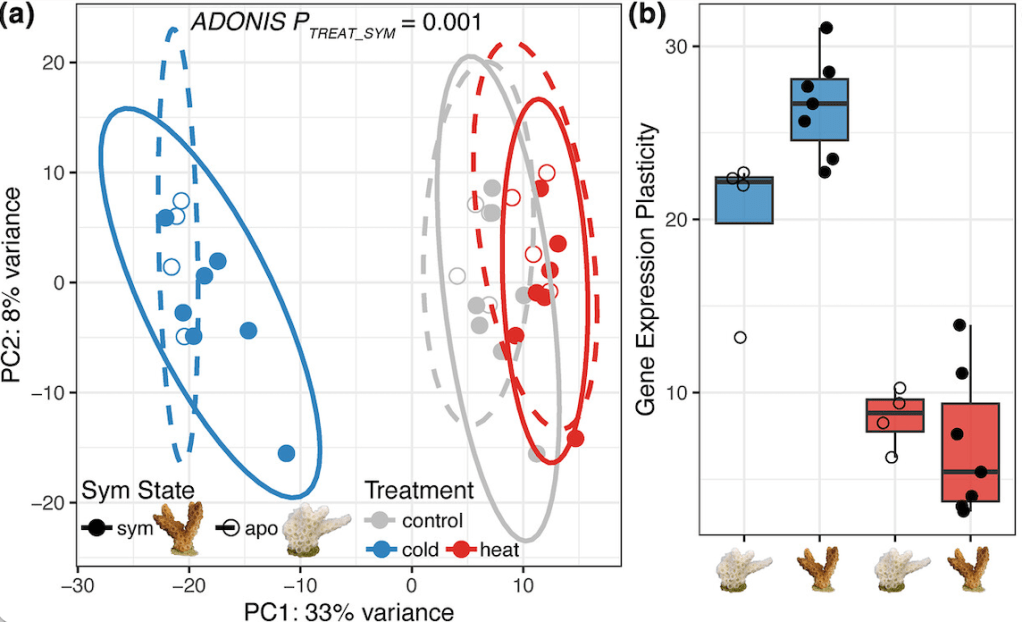
Most tropical corals require algae to survive, and when ocean temperatures become too hot, they expel their algae in a stress response. However, some species of coral are facultatively symbiotic. We studied the stress response in thermal extremes to two facultatively symbiotic corals. I performed RNA extraction to prepare the coral samples for metagenome sequencing. This data was used to study the magnitude of the stress response for both the coral hosts and the algal symbionts.
Figure credit: Aichelman et al. 2024
Publications:
Aichelman, H. E., Huzar, A. K., Wuitchik, D. M., Atherton, K. F., Wright, R. M., Dixon, G., Schlatter, E., Haftel, N., & Davies, S. W. (2024). Symbiosis modulates gene expression of symbionts, but not coral hosts, under thermal challenge. Molecular Ecology, 33(8), e17318.
Wuitchik, D. M., Aichelman, H. E., Atherton, K. F., Brown, C. M., Chen, X., DiRoberts, L., Pelose, G. E., Tramonte, C. A., & Davies, S. W. (2024). Photosymbiosis reduces the environmental stress response under a heat challenge in a facultatively symbiotic coral. Scientific Reports, 14(1), 1-13.

Predicting the Soil Microbiome
Boston University BRITE Program, Summer 2018
The soil microbiome composition can affect ecosystem function. Different taxa thrive under different conditions, such as nutrient availability, temperature, and moisture. We created a model to predict the presence of microbes in the environment and found that microbiome predictability increases with spatial and taxonomic scales.
This work was named one of the Top 10 papers on Mycorrhizal Research published in Spring 2021 by the International Mycorrhizal Society.
Publication:
Averill, C., Werbin, Z. R., Atherton, K. F., Bhatnagar, J. M., & Dietze, M. C. (2021). Soil microbiome predictability increases with spatial and taxonomic scale. Nature Ecology & Evolution, 5(6), 747-756.
Benzene REduction THERapy
Purdue University iGEM Team, Summer & Fall 2017
Benzene is a carcinogen that is found in vehicle emissions, cigarette smoke, and the byproducts of oil refineries and petrochemical plants. Our team developed BREaTHER (Benzene REduction THERapy), a strain of E. coli that expresses a pathway that breaks down benzene into compounds that are safe for the human body. Check out our work here.
Photo credit: Purdue iGEM 2017
Our team earned a Silver Medal at iGEM 2017.
My research has been supported by the following organizations:






 Kathryn Atherton